PTP, a key Asian hub for Gemini network
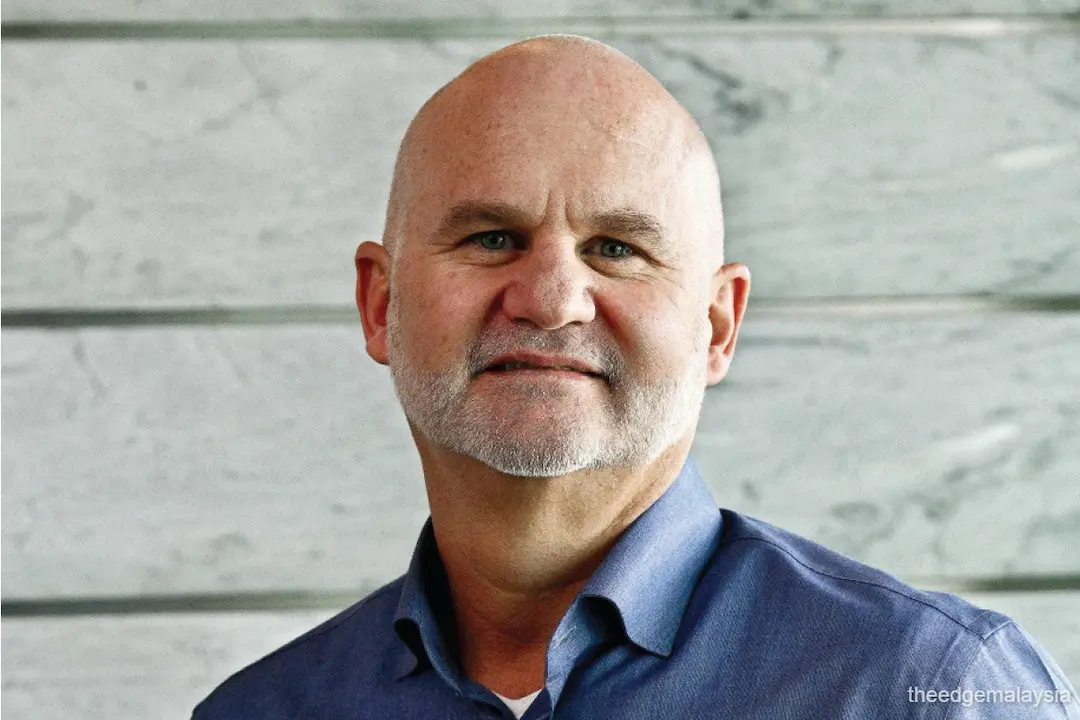
Hardiman: We’ve been with Maersk since day one. It’s not just a commercial relationship but a strategic one. The trust they placed in us is what led them to anchor Gemini’s Asian hub here . (Photo by Sam Fong/The Edge)
AFTER 25 years, the Port of Tanjung Pelepas (PTP) is running out of space: it is building the last quay extension of its container terminal that would bring its annual safe operating capacity to 16.5 million 20-foot equivalent units (TEUs).
The current capacity expansion plan — the 340m quay extension as well as investing in 15 new quay cranes — will be completed in mid-2028, says CEO Mark Hardiman in an interview with The Edge at the port, which is located in Gelang Patah, Johor.
“Safe operating capacity at the moment for us, if annualised, is 14 million TEUs.
“With the addition of those cranes, we’re going to, in stages, go up to 15 million and ultimately by the middle of 2028 — but the full annualised impact would be in 2029 — achieve 16 million TEUs of annual capacity.”
“That’s all we can do here,” says Hardiman, who was appointed as head of Malaysia’s largest transshipment hub in 2024.
A beneficiary of the Gemini Cooperation, the world’s second largest container shipping alliance consisting of Maersk and Hapag-Lloyd, PTP handled 12.3 million TEUs last year, a 17.13% increase from 10.5 million TEUs in 2023.
The Gemini Cooperation operates on a hub-and-spoke transshipment model, comprising 340 vessels, aggregating around 3.7 million TEUs and covering 57 services including mainliner and dedicated shuttle services.
In comparison, the Port of Singapore saw a 5.44% increase in its container throughput last year, handling 41.12 million TEUs, while Westports Holdings Bhd (KL:
WPRTS) handled 10.98 million TEUs, a marginal increase from the 10.88 million TEUs in 2023.
PTP’s 12.3 million TEUs of container throughput in 2024 made it the 15th largest port globally as ranked by Drewry. It is also the fastest-growing terminal in Southeast Asia, achieving a container throughput CAGR (compound annual growth rate) of 4.1% from 2014 to 2024.
In March 2023, then CEO Marco Neelsen told the media that the port had a five-year RM3 billion capital expenditure (capex) plan, starting in 2024, to expand its capacity to 16.5 million TEUs.
Besides the 15 quay cranes that have been ordered — they are scheduled for delivery between now and January next year — as well as the quay extension, PTP is also investing in 58 electrified rubber-tyred gantries (RTGs) to raise the intensity of its existing footprint.
“We’re putting in as much equipment as we can and that allows us to do very high throughput,” says Hardiman, adding that further capacity expansion beyond the current plan would require more land.
“Then, of course, we still have to determine that — that’s not finalised yet,” he says. “That’s where we talk about PTP’s future or ‘PTP2’.”
PTP is a joint venture between MMC Ports Holdings Sdn Bhd, the port-operating arm of MMC Corporation Bhd, and APM Terminals, the terminal-operating arm of Maersk.
MMC Ports is heading for an initial public offering (IPO) on Bursa Malaysia. The port group — which owns, besides PTP, Northport (M) Bhd, Penang Port Sdn Bhd, Johor Port and Tanjung Bruas Port in Melaka — is reportedly expected to raise almost RM7 billion through the IPO. The retail and institutional offering price had yet to be determined as at press time.
The draft prospectus for the IPO, which was uploaded on Securities Commission Malaysia’s website on June 30, does not provide details of any future expansion of PTP beyond the current port limit and concession.
Intensifying the port’s operational capacity based on its existing footprint is Hardiman’s strategy of growing container throughput. This includes the development of Phase 3 of the Pelepas Free Zone, which is aimed to be completed by mid-2030.
The current Phases 1 and 2 of the free zone cover an area of 294.8ha, with over 90% of the land being subleased to local and global companies to be used as warehouses and light manufacturing operations.
Pelepas Free Zone also comprises Phases 4 and 5, which cover 156.4ha and 101.2ha respectively, according to MMC Ports’ draft prospectus. These areas are not the subject of current expansion plans and are being held for future development, the group states.
Major developments are being undertaken in Straits of Malacca ports, including the Tuas Mega Port in Singapore as well as Westports 2 in Port Klang. The former will have a container handling capacity of 65 million TEUs by 2040, while Westports 2 Phase 1 aims to uplift the terminal’s capacity to 27 million TEUs by 2030, from the current 14 million TEUs.
Meanwhile, the government is still studying the feasibility of the Carey Island Port, which, upon completion in 2060, should have 60 million TEUs of container handling capacity.
Asked if PTP’s expansion was keeping pace with that of regional rivals such as Singapore’s Tuas Port and Westports, Hardiman says there is room for multiple players. “There is sufficient demand for the capacity. Each of us has our loyal customer base … and offers different things. As long as we all perform, I think there will be sufficient [demand] for all of us.”
Leveraging on Gemini for future growth, not courting MSC
Prior to 2024, PTP had a rather tough couple of years with its container throughput declining to 10.5 million TEUs in 2022 from 11.2 million TEUs in 2021. Initially, 2023 was also expected to be another challenging year for PTP as major shipping alliances reorganised.
However, PTP managed to maintain its container throughput in 2023, partly due to the Red Sea shipping crisis that disrupted global trade routes and created spillover opportunities in Southeast Asia. “We were able to capitalise [on the Red Sea crisis] and take on more than a million TEUs above what we had expected for the year,” says Hardiman. “That [growth] was opportunistic.”
In contrast, he describes 2024 as a structured growth year driven by PTP’s strengthened role in the Gemini network. “Maersk and Hapag-Lloyd combined is approximately 85% of our volume … Gemini is probably around 60% of our volume.”
The improved efficiency of Gemini operations has helped lower container dwell time — the period containers remain in the yard — allowing PTP to temporarily push throughput beyond its safe capacity, he adds. “If the containers are staying in the yard for six days versus four days, four days we have a lot more capacity,” he said. “That’s why we’ve managed to do above 14 million TEUs on an annualised basis [this year].”
The current deep relationship with Maersk and the Gemini network may have led to PTP’s decision to not actively court the world’s largest container shipping operator Mediterranean Shipping Company (MSC) to use the port as its major transshipment hub in Asia.
“When they [Maersk] decided to change their network and do Gemini … they approached us.
“Of course, we did and here we are now, expanding and enjoying record volumes,” says Hardiman, explaining how PTP became part of the Gemini network.
The port’s strategic relationship with Maersk, a shareholder through APM Terminals, began in 2000 when the shipping line moved operations from Singapore.
The reshuffling of the container shipping alliances in 2023 involved the breaking up of the 2M Alliance consisting of Maersk and MSC. Prior to that, PTP was one of the main hubs for 2M in Asia, alongside the Port of Singapore.
MSC, which currently handles over 23 million TEUs annually and commands roughly 19.9% of global container shipping capacity, has increasingly bypassed traditional alliances and developed its own terminal infrastructure, including in key hubs such as Singapore, the Port of Tanjung Priok in Jakarta and Indian subcontinent ports.
While Singapore’s PSA Tuas port is a major MSC partner and Westports in Port Klang has handled MSC volumes, Hardiman’s comments signal that PTP’s operational alignment with Maersk limits the feasibility or desirability of courting its direct rival.
“We’ve been with Maersk since day one. It’s not just a commercial relationship but a strategic one,” says Hardiman. “The trust they placed in us is what led them to anchor Gemini’s Asian hub here.”