Tanjung Pelepas – Malaysia
Container Management
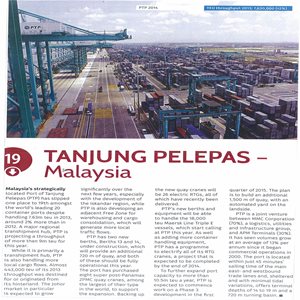
Malaysia's strategically located Port of Tanjung Pelepas (PTP) has slipped one place to 19th amongst the world's leading 20 container ports despite handling 7.63m teu in 2013, around 2% more than in 2012. A major regional transhipment hub, PTP is projecting a throughput of more than 9m teu for this year.
While it is primarily a transhipment hub, PTP is also handling more local cargo flows. Almost 443,000 teu of its 2013 throughput was destined for or originated from its hinterland. The Johor market in particular is expected to grow significantly over the next few years, especially with the development of the Iskandar region, while PTP is also developing an adjacent Free Zone for warehousing and cargo consolidation, which will generate more local traffic flows.
PTP has two new berths, Berths 13 and 14 under construction, which will provide an additional 720m of quay, and both of these should be fully operational this year. The port has purchased eight super post- Panamax ZPMC quay cranes, among the largest of their type in the world, to support the expansion. Backing up the new quay cranes will be 26 electric RTGs, all of which have recently been delivered.
PTP's new berths and equipment will be able to handle the 18,000 teu Maersk Line Triple E vessels, which start calling at PTP this year. As well as adding more container handling equipment, PTP has a programme to electrify all of its RTG cranes, a project that is expected to be completed by the end of 2014.
To further expand port capacity to more than 10.5m teu a year, PTP is expected to commence work on Phase 3 development in the first quarter of 2015. The plan is to build an additional 1,500 m of quay, with an automated yard on the landside.
PTP is a joint venture between MMC Corporation (70%), a logistics, utilities and infrastructure group and APM Terminals (30%). It has seen volumes grow at an average of 13% per annum since it began commercial operations in 2000. The port is located within just 45minutes sailing time of the main east and westbound trade lanes and, sheltered and with minimal tidal variations, offers terminal depths of 14 to 19m and 720m turning basin.
![]()