Tanjung Pelepas plans 45% decarbonization by 2030
Shipping Watch
View Source 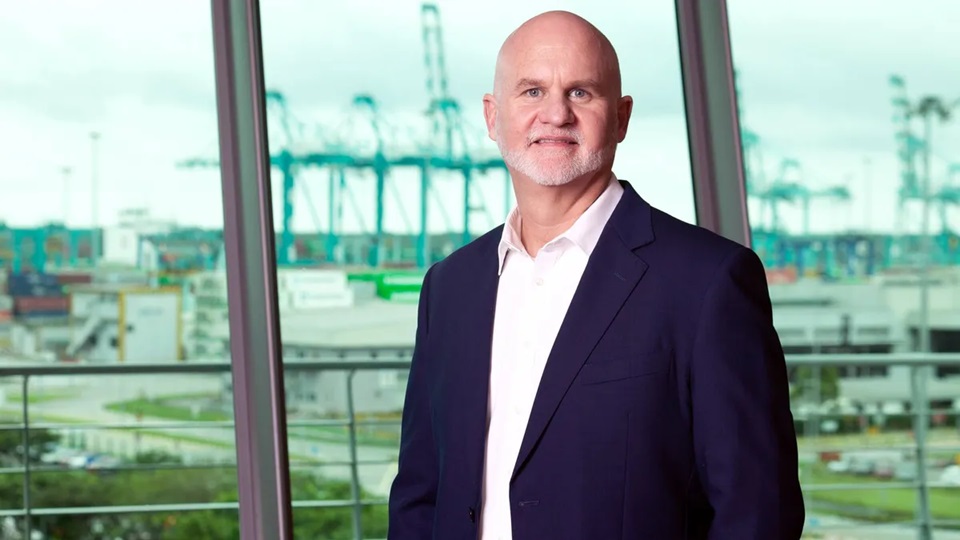
Electrical prime movers and green tugboats are two of the cornerstones in Tanjung Pelepas’ plan to reduce its carbon footprint substantially over the coming years.
With chief executive Mark Hardiman at the helm of one of Southeast Asia’s most important container ports, the ambition is to decarbonize operations with 45% by 2030 against baseline data of 2021.
So far, the entire fleet of RTGs, the rubber tyred gantry cranes, are electrified, meaning that all mobile cranes that ground and stack containers are plug and drive vehicles.
Expects to win from Gemini
Planned to launch in February next year, the new Danish-German Gemini cooperation will reshuffle the container network, dividing ports and terminals into hubs and spokes – core ports and those connected to the main hubs through new shuttle services.
Tanjung Pelepas will become an important hub in Asia going foward.
In an interview with ShippingWatch in October, Tanjung Pelepas CEO Mark Hardiman expressed confidence that Gemini will ”mean a lot” to the business and said:
”The obvious impact from the hub and spoke concept is that it will give us a lot more volume. Essentially, we will be the center for the shuttles coming in to the main liners.”
The biggest chunk, however, comes from the fleet of tractors which emit 65% of all greenhouse gases at the port.
”The conversion of the RTGs has been a big contributor towards decarbonization. The big buckets we have to tackle now in order to achieve the goal are our prime movers, horizontal movements, like our tractors,” Mark Hardiman tells ShippingWatch.
Entirely diesel-powered today
”That fleet, at the moment, is entirely diesel, and that’s the big pool we are attacking now in terms of conversion to electricity. Before the end of this year, we will be placing our first order for electrical prime movers,” he adds.
After the tractors, it is time to decarbonize the marine fleet.
Unlike some of its competitors, Tanjung Pelepas is in charge of all marine ports operations, pilots and tug boats. Moving forward, Tanjung Pelepas plans to move away from diesel- and petrol-powered tugboats and pilot boats. The port is ”looking at different technologies” in collaboration with, among others, IMO.
And to be able to source its own electrical power, the port is exploring the potential of solar panels and implemented a plan to cover all roof space with panels.
He agrees that automatization of operations, the cranes for instance, holds a large potential to further decarbonization. Tanjung Pelepas is not there yet, ready to kick-off a process that other ports have initiated, but which often comes with a price and resistance from staff and unions.
Cautiously taking steps
For instance, Singapore’s new mega port Tuas will be automatic, leaving manual operations to a minimum. Tanjung Pelepas is cautiously taking its first steps towards automatization and is conducting trials. But apart from a digital twin able to reduce unnecessary driving, there is still no equipment that has been automated.
”When you think about ports and automation, you are talking about the cranes, the RTGs and the prime movers. Those parts we don’t have automated now. We’re a legacy, traditional operating business on each one. The new RTGs we will be placing our next batch of orders for will have a degree of automation retrofit capabilities, and that’s what we’re planning to do. Firstly, remote operating and then ultimately automation,” Hardiman says.
Green bunkering is another means to decarbonize operations but certainly also to remain attractive to customers and shippers. With Maersk as the by far biggest customers, Tanjung Pelepas is betting on providing green methanol primarily. Bio-fuel is being tested. LNG is available. Ammonia is further down the road.
The port is still sourcing suppliers for green methanol which ”is taking time.” The port is currently working with Malaysia’s Ministry of Transport to make sure the regulatory framework is in place.
2M break-up
”Our main focus is on the methanol. I would say we are probably looking at a period of four to five years, in 2028 or 2029 when we will hopefully try to get something going in terms of the green methanol.”
Today, 2M accounts for 75 percent of the moves at Tanjung Pelepas, founded 24 years ago with Maersk’s ports company APM Terminals as one of the two partners, and Malaysia’s MMC Group weighing in with 70 percent of the share capital.
This 75 share of moves may not continue when 2M ends in February next year and Maersk launches its new cooperation with Hapag-Lloyd, Gemini.